
Do You Need Extra Insurance for Airbnb in NZ?
Thinking about listing your home or investment property on Airbnb? Your standard home and contents policy almost certainly wasn't written with paying guests in mind. Before you accept your first booking, here's what you need to know about airbnb insurance in NZ, and why getting it wrong can be an expensive lesson.

Years of experience
Clients protected
5-star reviews
Your home insurance probably doesn't cover this
Most people assume their home insurance has them covered. It's a reasonable assumption, until a guest breaks a window, floods the bathroom, or slips on your deck and decides to make it your problem.
Standard home and contents policies are written for one specific scenario: you, living in your own home or renting it out to long term tenants. The moment you start accepting money from strangers to stay there, the nature of the risk changes. Insurers know this. Most policies have clauses that exclude or limit cover when the property is being used for commercial purposes, and short-term letting almost always qualifies.
That doesn't mean you can't get the right cover. It means you need to know what you're working with before something goes wrong.
What actually changes when you list on Airbnb
When a paying guest stays at your property, a few things shift from an insurance perspective.
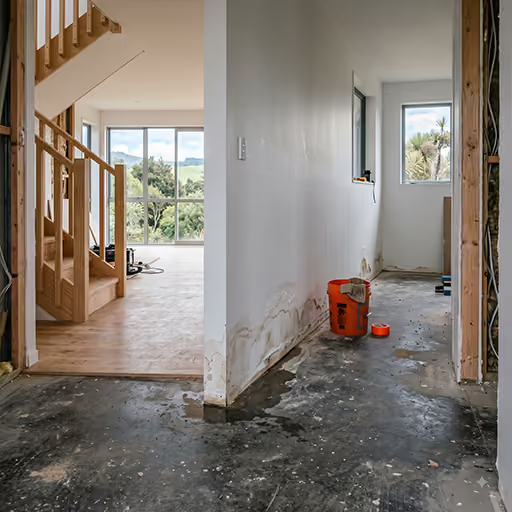
First, the risk profile changes. Guests don't treat a property the same way an owner does. That's not a criticism, it's just reality. Higher turnover means more wear, more chance of accidental damage, and more people who don't know where the stopcock is when a pipe bursts.
Second, the commercial use question kicks in. Insurers distinguish between a property used as a home and a property used to generate income. Once you're charging guests, you're in commercial territory, even if it's just one room, even if it's only occasional.
Third, liability becomes more complicated. In New Zealand, ACC handles personal injury claims on a no-fault basis, which does reduce some of the liability exposure you'd face in other countries. But ACC doesn't cover property damage, legal costs, or claims that don't fit neatly into the personal injury category. If a guest damages a neighbour's property, or you're sued for something that falls outside ACC's scope, your standard home policy may not respond.
Occasional letting vs. running a short-term accommodation business
There's a meaningful difference between renting out your spare room a few weekends a year and running a property as dedicated short-term accommodation.
Insurers treat these differently, and so do local councils.
For occasional letting, say, a few nights here and there while you're away, some insurers will extend cover if you notify them in advance. Others won't. The only way to know is to ask, in writing, before you list. Don't assume silence means approval.
For regular or full-time short-term letting, a standard home policy almost certainly won't cut it. At that point, you're looking at either a dedicated short-term accommodation policy or a commercial landlord policy, depending on how the property is used and how often it's let.
The line isn't always obvious. That's exactly the kind of question worth putting to a broker who can look at your specific situation and tell you where you actually stand.
What local councils have to do with it
Insurance isn't the only thing that changes when you start letting short-term. Many local councils across New Zealand have rules around short-term accommodation, resource consent requirements, rating classifications, and in some cases, registration or compliance obligations.
These vary significantly by district. What applies in one area won't necessarily apply in another. It's worth checking with your local council before you list, not just for insurance purposes, but to make sure you're operating within the rules. A policy won't protect you from a compliance issue, and a compliance issue can affect your ability to let at all.
What can go wrong, and what you want covered
Let's be specific about the risks, because vague warnings don't help anyone.
Guest damage. Accidental damage by guests is one of the most common claims short-term hosts face. Broken furniture, stained carpets, a smashed rangehood, these things happen. Whether your policy covers them depends entirely on whether you've disclosed the letting activity and whether your policy is written to include it.
Theft. A guest walking out with your television or jewellery is a different scenario to a break-in. Some policies treat theft by a person who was lawfully on the premises differently to theft by an intruder. Worth understanding before you hand over a key.
Liability for guest injury. As mentioned, ACC covers personal injury in most circumstances. But liability cover still matters for scenarios that fall outside ACC, property damage caused to third parties, legal defence costs, or claims in grey areas. If a guest injures themselves and ACC doesn't fully apply, or if they pursue a civil claim for something other than personal injury, you want cover behind you.
Loss of rent after an insured event. If your property is damaged and uninhabitable, say, after a fire or a significant flood, you lose income while repairs happen. Loss of rent cover compensates for that. It's not automatic on a standard home policy, and it's worth asking about specifically.
Why platform protection schemes aren't enough
Most major short-term letting platforms offer some form of host protection programme. These can be useful, but they're not insurance, and treating them as a substitute is a mistake.
Platform protection schemes are typically discretionary. The platform decides whether to pay, under what circumstances, and how much. They have exclusions, caps, and processes that differ from a regulated insurance policy. They're also not subject to the same regulatory oversight as a licensed insurer in New Zealand.
A proper insurance policy, issued by a regulated insurer, gives you enforceable rights. If a claim is declined unfairly, you have recourse, through the insurer's complaints process, through the Insurance and Financial Services Ombudsman, and through your broker, who can advocate on your behalf. With a platform scheme, your options are more limited.
Use the platform's programme for what it is, a supplementary layer. Don't rely on it as your primary protection.
The disclosure issue, this is the one that catches people out
Non-disclosure is one of the most common reasons insurance claims get declined in New Zealand.
Here's how it plays out: a host lists their property, doesn't tell their insurer, something goes wrong, they make a claim, and the insurer discovers the property was being used for short-term letting. The claim gets declined, not because the damage wasn't real, but because the risk wasn't what the insurer agreed to cover.
The fix is simple, but it has to happen before the claim, not after. Tell your insurer you're planning to let short-term. Get their response in writing. If they won't extend cover, find a policy that will, because operating without proper disclosure isn't a grey area, it's a gap that will cost you.
What to ask for when you're getting cover
If you're talking to a broker or insurer about cover for short-term letting, here are the questions worth asking:
- Does this policy cover short-term letting, and under what conditions?
- Is guest damage, accidental and intentional, included?
- What's the position on theft by a guest?
- Is liability cover included, and what does it actually cover given ACC's role in NZ?
- Is loss of rent included if the property becomes uninhabitable after an insured event?
- Are there any conditions around how often I can let before the policy changes?
Get the answers in writing. Verbal assurances don't help at claim time.
When it's time to talk to a broker
If you're letting occasionally and want to check your existing policy is adequate, a quick conversation with your insurer, documented in writing, might be enough.
But if you're letting regularly, managing multiple properties, or thinking about scaling up, you're moving into territory where a broker earns their keep. The difference between a standard home policy, a short-term accommodation policy, and a commercial landlord policy isn't just price, it's what gets paid when something goes wrong.
At Gerrards, we work with property owners across New Zealand who are at exactly this point. We compare policies across more than 30 insurers, so you're not stuck with whatever one company happens to offer. And if you ever need to make a claim, we're in your corner, not the insurer's.
Every property situation is different. Get in touch and we'll give you a straight answer about where you actually stand.
This is general information only. For advice tailored to your situation, get in touch with our team.
Meet the author
See the author who wrote this article



























Secure the exact cover your business needs
Getting insured shouldn't be a headache. We use innovative technology to strip away the paperwork and deliver a tailored, accurate quote in record time.